
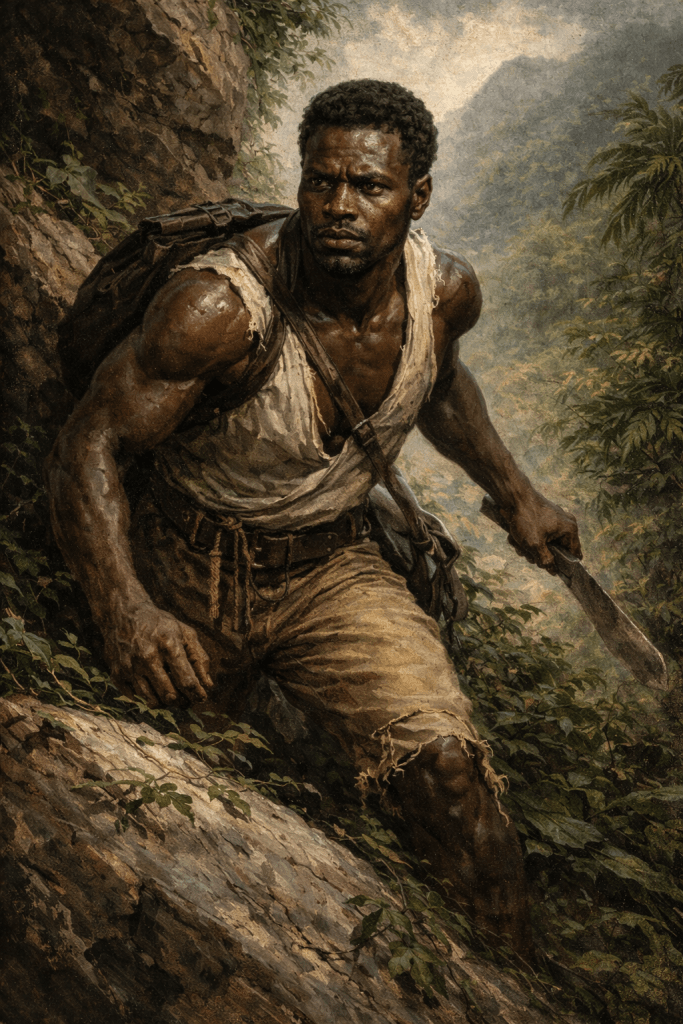
A narrative account of Marcus Davis aka Marcus of the Woods, an enslaved man from St.Kitts who was labeled a “notorious runaway,” revealing how resistance, fear, and survival shaped colonial Caribbean slavery.
Enslaved people in St. Kitts repeatedly sought freedom through maroonage, carving out temporary communities in the island’s rugged interior despite overwhelming odds. From the earliest years of settlement through the era of so-called emancipation, these escapes reflected a consistent refusal to accept bondage—whether enforced by chains or by law.

Resistance to Slavery:
One of the earliest documented acts of maroon resistance occurred in 1639, when around 60 enslaved people fled a plantation in Capisterre and established a settlement on the slopes of Mount Misery. Alarmed by the scale of the escape, colonial authorities dispatched soldiers to suppress the group. As early as 1639, Governor De Poincy recorded such deployments, revealing how seriously maroonage was perceived as a threat to colonial stability. Most of the escapees were eventually captured, but one man’s defiance elevated him to near-legendary status, underscoring how running away and resistance could resonate deeply within enslaved communities.
Despite these acts of resistance, permanent maroon societies like those established in Jamaica proved difficult to sustain in St. Kitts. The island’s small size limited geographic refuge, and colonial forces consistently mobilized soldiers to restore order and capture escapees. Still, the forested hills around Mount Misery became a recurring refuge, symbolizing both resistance and the limits imposed by colonial surveillance.

Elevation: 1,156 meters (3,793 feet).
Type: Stratovolcano.
Summit: Features a 1-kilometer wide crater with a lake and fumaroles, accessible by ladders from the rim.
Trail: A challenging jungle hike with slippery roots, steep inclines, and muddy sections, requiring good fitness and sturdy footwear.
Views: Panoramic vistas of St. Kitts, neighboring islands, and the crater itself.
History: Renamed from Mount Misery in 1983, reflecting its historical significance.
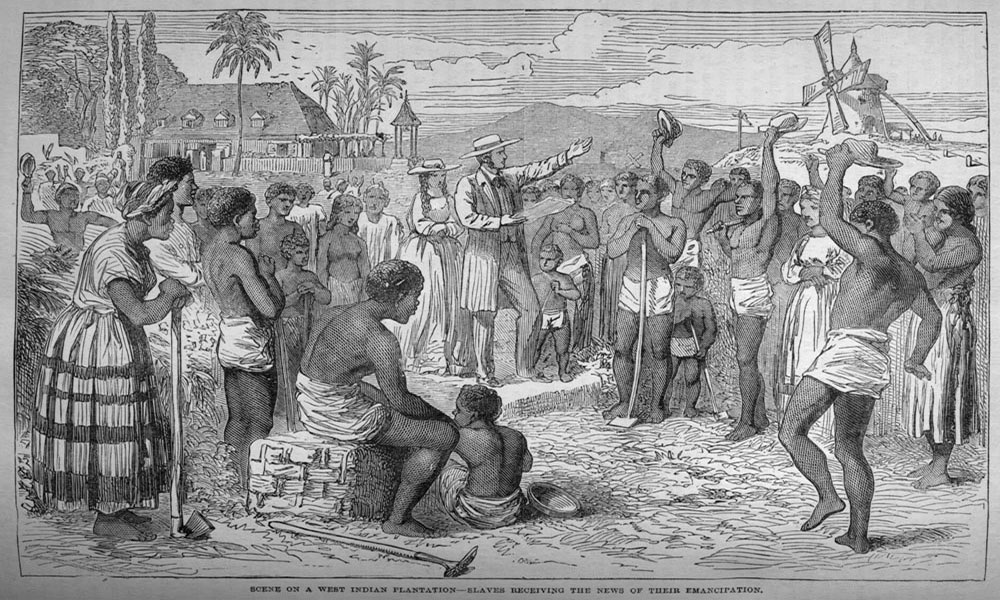
Nearly two centuries later, the struggle for freedom resurfaced during the upheaval that followed the 1834 Emancipation Act. While the law nominally ended slavery, it imposed a compulsory apprenticeship system that bound formerly enslaved people to their former masters. Many refused to accept this partial freedom. Widespread unrest followed, with large numbers once again escaping to the hills, reviving maroon traditions as a direct challenge to the colonial order.

Among the most significant figures of this period was Marcus Davis aka “Marcus of the Woods.” Marcus of the Woods stands as a legendary Maroon and freedom fighter in St. Kitts and Nevis, remembered for his persistence, leadership, and refusal to accept bondage as his fate. An enslaved African on Hutchinson’s estate, his resistance unfolded over decades. By 1815, Marcus had been captured and compelled to perform public work on the plantation, a visible reminder of the system’s effort to break both body and spirit.
Marcus reappears in the Slave Register of 1829, listed as having been acquired by “purchase from the public” by Anthony Cunyngham. Two years later, in 1831, he absconded again—this time alongside more than 30 enslaved Africans—signaling that his resistance had grown into something larger and more collective.
On the Run Again
In 1834, he escaped once more into the mountains, choosing the rugged interior over a life of forced labor. By that same year, the movement had swelled, with more than 94 enslaved Africans fleeing from various plantations to the hills. These escapes transformed the interior into spaces of defiance and hope, even as colonial authorities struggled to reassert control.
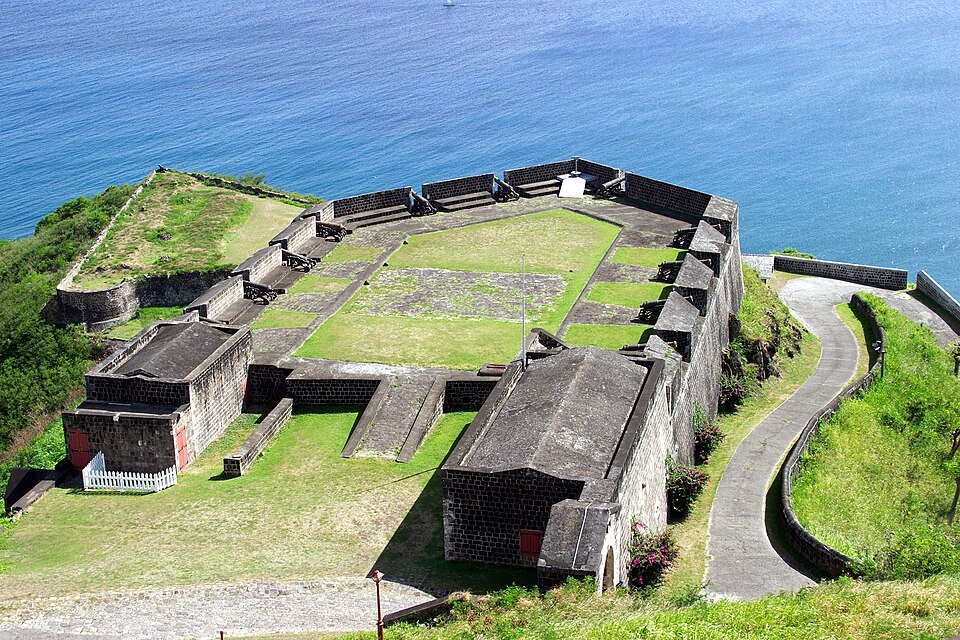
Operating on the leeward side of the island between Stone Fort and Vambelle, within sight of Brimstone Hill Fortress, Marcus and his companions acted in the shadow of colonial power, underscoring the limits of military control.
leadership:
By 1834, amid unrest following the Emancipation Act and its coercive apprenticeship system, Marcus had become one of the most wanted men on the island. He was now accused of murder, known to carry and skillfully use a musket, and believed to be sheltering in the mountainous interior. During Martial Law, troops were sent into the hills to demonstrate that no refuge was beyond reach. Marcus was sighted during one operation, but escaped once again when a guide inadvertently revealed the soldiers’ approach.
The fear he inspired was explicit. In a letter dated 11 August 1834, estate manager A.P. Pogson warned that “no order may be expected in the country unless he [Marcus] is taken.” At the same time, colonial reports acknowledged the broader crisis: 94 enslaved people were absent from estates across St. Kitts, many drawn into the same networks of flight and resistance Marcus embodied
Emerging as a leader during the 1834 unrest, Marcus reportedly led close to 100 runaways into the interior. Colonial authorities were unable to capture him, and his continued freedom transformed him into a powerful symbol of defiance—proof that true emancipation could not be legislated without consent. Unlike so many others whose stories end in recapture or execution, Marcus of the Woods disappears from the historical record on his own terms. He was never captured again.
FREEDOM IS A MUST!
His story ends not with execution, imprisonment, or submission, but with absence—an unresolved ending that itself stands as a form of victory. In that disappearance, Marcus becomes more than a man. He becomes a symbol of maroon resistance in St. Kitts: relentless, adaptive, and unwilling to accept freedom on colonial terms.
His life reminds us that emancipation was not simply granted—it was contested, resisted, and, in cases like Marcus of the Woods, actively seized.
Yet the legacy of maroon resistance in St. Kitts endures. From the unnamed man executed after the 1639 Capisterre Escape to leaders like Marcus of the Woods, these acts of flight and defiance reveal a persistent and deeply rooted demand for freedom—one that refused compromise, even when emancipation was declared but not fully delivered.
I do not think many people know of Marcus of the Woods. He should definitely be named one of our National Heroes!
🌺🌸Buy me a coffee ☕️ please🌺🌸

LEARN U.S. HISTORY and LITERATURE WITH ME: