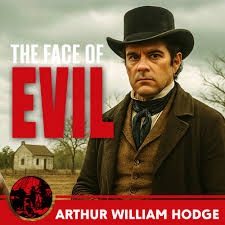
Explore the historic trial and hanging of Arthur Hodge, a rare case of a white planter held accountable for violence against an enslaved person in the Caribbean. What led to this shocking conviction?
⚠️ Trigger warning graphic human cruelty. This is the second part of a two part series. Read part one for background information.
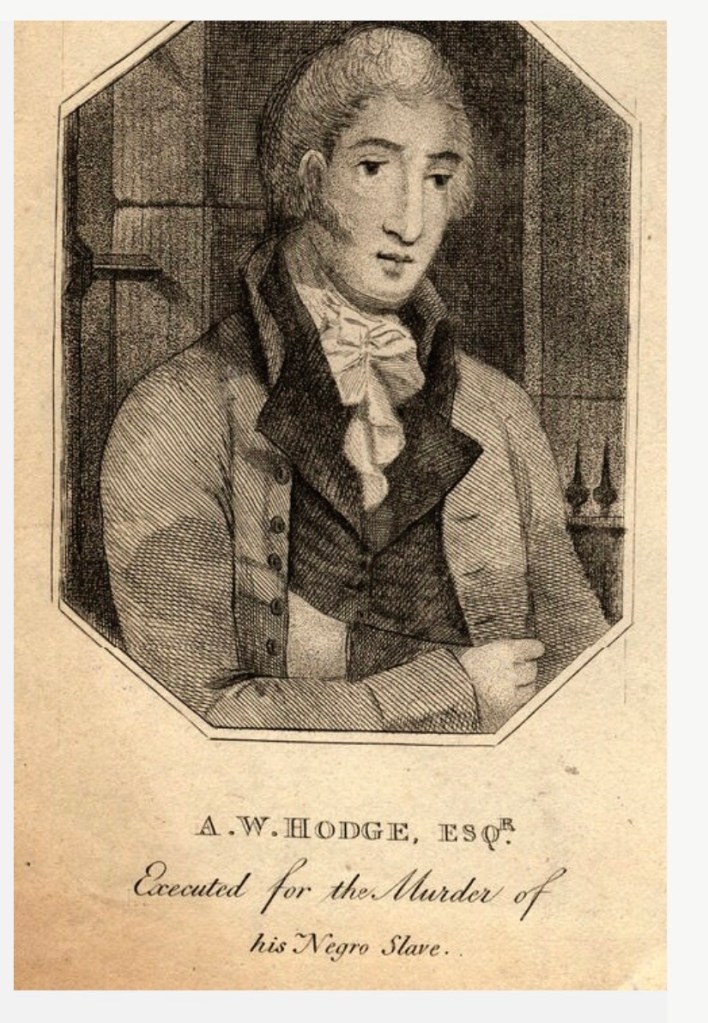
In early October 1807, on a Caribbean plantation governed by violence and unchecked authority, an enslaved man named Prosper became the focus of his enslaver’s rage. The assaults began on 2 October 1807 and continued into the next day. Less than two weeks later, on 15 October 1807, Prosper died from his injuries.
The incident that triggered the violence was painfully small.
“Prosper had been tasked by Arthur to let nothing happen to a mango which hung on a branch of a tree. Most of all, Prosper was not to let it fall to the ground. But it did fall and when he couldn’t pay the 6 shillings Hodge demanded of him, he was whipped unconscious.”
To clarify, A mango had fallen from a tree. Hodge demanded payment for the fruit, and when Prosper could not produce the money, he was punished. Over consecutive days, Prosper was flogged 100 times, beaten again and again until he was too weak even to cry out.
Witnesses later described how Prosper was carried to the plantation sick-house and abandoned there without rations or care. Some days later, he was discovered dead. Testimony presented to the court described his condition in stark terms:
“found there dead, and in a state of putrefaction, some days afterwards; that crawlers were found in his wounds, and not a piece of black flesh was to be seen on the hinder part of his body where he had been flogged.”

Despite the severity of what had happened, Arthur Hodge was not immediately charged. It would take three years before he was indicted, on 11 March 1811. By then, Hodge had fled from his estates and was eventually arrested under warrant.
⸻
The Trial

The most significant evidence at trial came from Perreen Georges, a free woman of color who had witnessed Prosper’s punishment. Her testimony laid out how a demand for payment escalated into sustained brutality:
“I was present when he [Prosper] was laid down and flogged for a mango which dropt [sic] off a tree, and which Mr Hodge said he should pay six shillings for; he had not the money and came to borrow it of me, I had no more than three shillings; he said to his master that he had no more money; his master said he would flog him if he did not bring it; he was laid down and held by four negroes, on his face and belly, and flogged with a cartwhip; he was under the last better than an hour; he then got up and was carried up to the hill; and his master said he should be flogged again if he did not bring the other three shillings; he was tied to a tree the next day; and the flogging was repeated; he was licked so long that his head fell back, and he could not bawl out any longer; I supposed he was faint; I then went from the window, as I could not bear to see any more of it.”
Her testimony made clear that this was not a moment of excess, but a deliberate punishment carried out over time, even as Prosper’s condition visibly deteriorated.
The prosecution’s case was strong. Stephen McKeough, a white man who inspected the Hodge estate, corroborated the severity of Prosper’s injuries. Daniel Ross, a Justice of the Peace, testified about the circumstances following the punishment. Hodge attempted to discredit McKeough as a drunk and Georges as a thief, but did not challenge Ross’s credibility.

In his defense, Hodge called his sister, Penelope, and a witness described as an “old black woman.” Contemporary accounts suggest their testimony was not regarded as credible.
As was customary, Hodge addressed the jury before deliberations. He said:
“As bad as I have been represented, or as bad as you may think me, I assure you that I feel support in my afflictions from entertaining a proper sense of religion. As all men are subject to wrong, I cannot but say that the principle is likewise inherent in me. I acknowledge myself guilty in regard of many of my slaves, but I call God to witness to my innocence in respect to the murder of Prosper. I am sensible that the country thirsts for my blood, and I am ready to sacrifice it.”
The jury were also charged with the words of Richard Hetherington, President of the Council of the Territory, who framed the decision in moral and legal terms:
”…the law makes no distinction between master and servant. God created white and he created black creatures; and as God makes no distinction in administering justice, and to Him each is alike, you will not, nor can you alter your verdict, if murder has been proved – whether on white persons or on black persons, the crime is equally the same with God and the law.”

⸻
Verdict and Execution
On 30 April 1811, the jury retired at about half past six in the morning. By eight o’clock, they returned with a guilty verdict. A majority recommended mercy, but the recommendation was not binding. Chief Justice Robertson sentenced Hodge to be “hanged by the neck on Wednesday the 8 May following, until he was dead, on a spot near unto the common prison.”
The verdict sent shockwaves through the colony. In the days before the execution, Tortola was heavily locked down to prevent unrest. Governor Hugh Elliot, who had pushed for the indictment, commissioned a militia, imposed martial law each night from sunset to sunrise, and ordered HMS Cygnet to stand by. Despite fears of disturbance, the public hanging went off without incident.
Hodge was allowed time to “make his peace with God.” He was attended by two ministers of the Methodist church at St Christophers. On the day of execution, he addressed individuals in the crowd, asking forgiveness for injuries he had caused, then asked forgiveness of the crowd as a whole. He was then hanged.
After his death, Hodge’s body was returned to his estate and buried not far from the grave of Prosper.
⸻
Context and Legacy
At the time of the trial, slavery remained legal, though the trade in enslaved Africans had been abolished by the Slave Trade Act 1807. Enslaved people would not be formally freed until the Slavery Abolition Act 1833.
During an unsuccessful bail application, Hodge’s counsel argued that “A Negro being property, it was no greater offence for his master to kill him than it would be to kill his dog.” The court rejected the argument without serious discussion.
The case exposed a contradiction at the heart of slavery: while human beings could be treated as property, their murder could still constitute a crime. In convicting Arthur Hodge, the court defied precedent and drew a rare legal boundary around violence that slavery usually excused.
Prosper did not live to see justice. But his death forced a reckoning—one that revealed both the brutality of slavery and the limits of what its laws could defend.
🌺🌸Buy me a coffee ☕️ please🌺🌸

LEARN U.S. HISTORY and LITERATURE WITH ME: